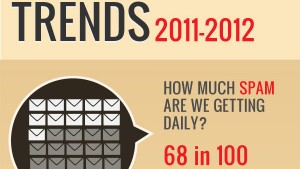
 Think you know spam? Think again. A bevvy of reports, all from valid and seemingly unimpeachable sources, have sprung up over the last year discussing the state of e-mail spam, and – surprise, surprise – no two reports seem to be able to agree on what’s happened to spam since Rustock was nuked off the face of the Earth.
My my. It’s like a bad April Fool’s Day prank, or at least near April Fool’s Day. It’s Friday, April 6, Good Friday, and the coffee is particularly warm and delicious for some reason. You pick up a copy of The Wall Street Journal – or, more accurately, sashay over to the WST web site – and browse the political section, having a few ripe chuckles at the expense of any one of the U.S. Presidential candidates. Then you tackle the word jumble and upon solving it, you wonder just how many ways The Hunger Games can find its way into modern pop culture – et tu, Wall Street Journal? Finally, you land on the Tech section, firmly expecting to read yet another story about Steve Jobs. Perhaps this one will be the much anticipated announcement by the Vatican that the dear departed Apple guru will be canonized. Saint Steve? Why not? Richard Branson’s been knighted, is all I’m saying.
To your immense surprise, you don’t see dark and mysterious rumors surrounding some groundbreaking new device created by Apple and poised to exploit the credit cards and kidneys of kids everywhere – iToaster, anyone? How about iVacuum, or iExpresso? No, instead you’re greeted with yet another article pitching the latest report about the state of e-mail spam. Yawn. Saint Jobs would be most fiery and brimstoney if he knew. Still, it is Good Friday and you have nothing better to do until mass at 3:00. So before using the virtual newspaper to line the virtual birdcage in your virtual penthouse, you go ahead and read the article, unsure of what it’s going to tell you. After all, the title is extremely mysterious and doesn’t give anything away. “Global Email Spam Falls.” Confusing, isn’t it? It’s like some elaborate riddle, created by Watson the supercomputer, encrypted using a 1,024 bit key, scrawled on a piece of paper in Egyptian hieroglyphics, and then digested by a meerkat for good measure. This one will make the Hunger Games jumble seem like the answer was something more obvious, like Twilight: New Moon. It will require all your gray matter to decipher this one, but since the coffee is particularly delicious this morning, you believe you’re up to the task.
The state of spam, the story informs you, has dropped substantially, according to a report released this week by Commtouch. This time last year, the number of spams being sent globally were ticking in at around 150 billion per day. In the first quarter of this year, the report goes on to state, daily spam rates were at about 94 billion per day. States Commtouch CTO Amir Lev, “spam is still four times the level of legitimate email and cybercriminals are increasing their revenues from other avenues, such as banking fraud malware.”
Whew. It was tricky, but it looks like we’ve solved the mystery. According to this cipher, global e-mail spam rates are down. This seems to be in sync with IBM X-Force, which published its annual 2011 Trend and Risk Report in March. This report also reported that spam is on the decline and attributes this to the high profile takedowns of botnets like Rustock; but it doesn’t go as far as identifying daily numbers and instead focuses on how certain types of spam – like image spam containing malicious attachments or links to malicious sites – are on the increase. Bottom line: the spammers are getting smarter, something we’ve been seeing for a while now.
GFI Software also conducted a study this year, and the results of that report are a little different. In that study, 72% of UK and US business reported that they are still seeing too much spam, and only 16% reported a decline in spam over the past year, while 52% reported an increase. While a little confusing, it seems like these reports can coexist. Studies, while conducted with the most scientific methods available, aren’t perfect. It’s very tempting to believe the companies – the actual users – interviewed in the GFI study, since the respondents are the ones dealing with spam day-in, day-out. It’s a little like the guys on the street holding the signs stating that the world will end. The specifics may not agree, but the final result has to.